Removing the cancer while honouring how you feel afterwards.
A breast cancer diagnosis arrives with fear — of the disease, and of what surgery might take away. Here, oncoplastic technique means both are treated with equal seriousness: complete cancer clearance AND a natural appearance, planned before the first incision.
A lump is a question, not a verdict.
Most breast lumps are not cancer — but every new lump deserves proper assessment: examination, imaging and, where needed, a biopsy with rapid pathology reporting so answers come in days, not months of waiting and worrying.
When cancer is confirmed, the modern question is no longer only “how much to remove?” but “what can we keep?” For many women, breast conservation surgery — lumpectomy with oncoplastic reshaping — treats the cancer as safely as mastectomy while keeping the breast looking natural. Where mastectomy is wiser, skin-sparing and nipple-sparing techniques, coordinated with reconstruction planning, preserve form and dignity.
Sentinel lymph node biopsy spares many women full armpit dissection and its after-effects. And for young women still planning families, fertility conversations happen before treatment begins — not after it's too late for options.
“સમયસર તપાસ જીવન બચાવે છે.” (A check-up done in time saves lives.) Early breast cancer found today is a very different journey than one found next year.
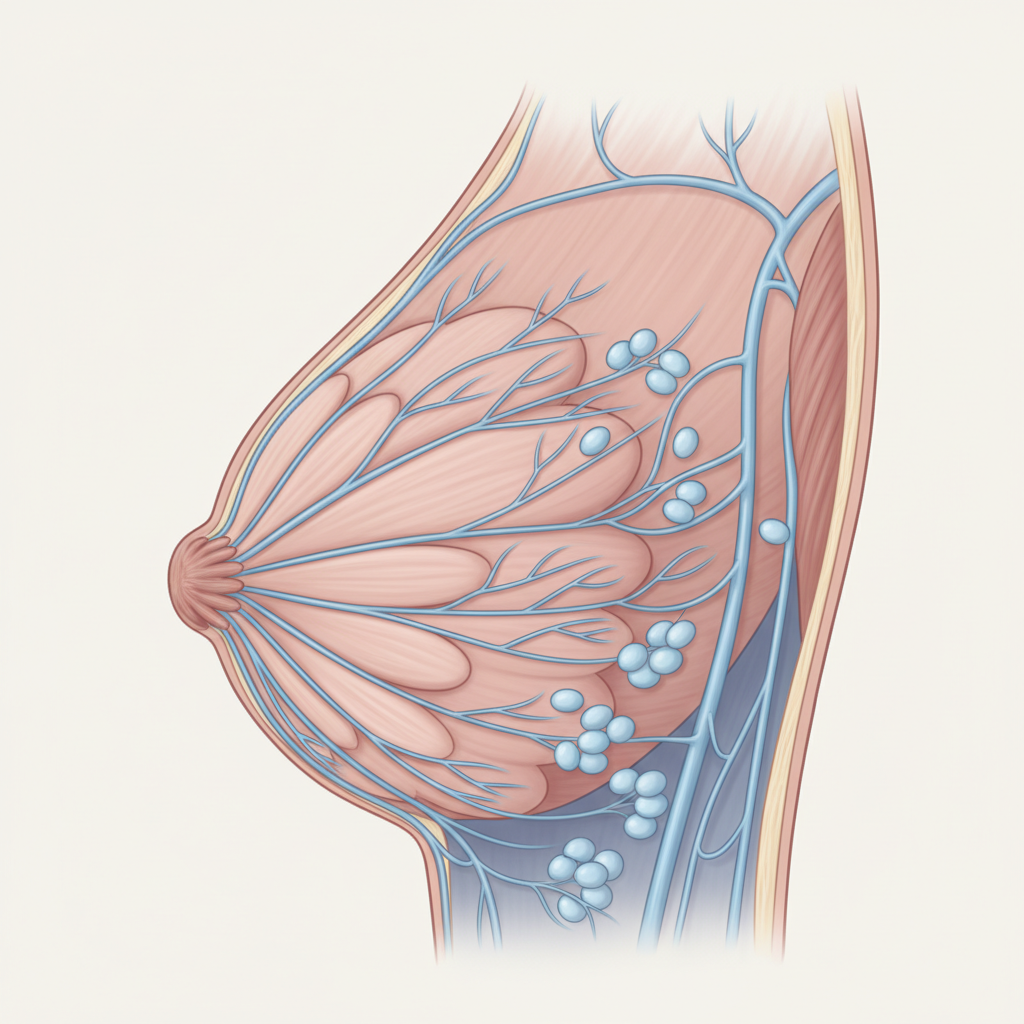
Changes that deserve an examination
Any one of these — even without pain — is worth showing to a specialist within days. Most will turn out innocent; the ones that aren't are exactly why we look.
- ①A painless lump in the breast — lumps that don't hurt get ignored longest.
- ②Skin dimpling that looks like orange peel over any part of the breast.
- ③Nipple retraction — a nipple newly pulled inward or pointing differently than before.
- ④Blood-stained discharge from the nipple, single duct or spontaneous.
- ⑤A change in size or shape of one breast that isn't part of your normal cycle.
- ⑥New asymmetry between the breasts developing over weeks or months.
- ⑦A lump in the armpit, even when the breast itself feels normal.
- ⑧Any new change that simply doesn't settle across a few weeks — bring it in, however small it seems.
What this speciality covers
◆Early Breast Cancer
Conservation-first planning — lumpectomy with oncoplasty wherever it is oncologically sound.
◆Mastectomy Choices
Simple, skin-sparing and nipple-sparing approaches discussed openly, decided with you — never for you.
◆Armpit (Axillary) Nodes
Sentinel biopsy to spare full dissection where safe; axillary clearance when nodes are truly involved.
◆Benign Breast Lumps
Fibroadenomas, cysts and cyclical changes — most lumps aren't cancer, but each gets proper assessment.
◆Reconstruction Coordination
Planned alongside plastic-surgery colleagues so timing and technique serve your recovery, not the calendar.
◆Young Women & Fertility
Fertility and family-planning counselling built into the first conversation, not the last one.
Operations performed here
- ✿Breast conservation surgeryLumpectomy with oncoplastic reshaping — the cancer cleared and the breast kept looking like itself.
- ✿Mastectomy — simple, skin-sparing, nipple-sparingThe right extent chosen for your tumour, your body and your wishes.
- ✿Sentinel lymph node biopsyDye-guided mapping that checks the first nodes — sparing full armpit surgery when they're clear.
- ✿Axillary dissectionPerformed when nodes are involved, with careful attention to arm comfort afterwards.
- ✿Oncoplastic techniqueCancer clearance and natural appearance addressed in the same operation, by design.
- ✿Benign lump excision & reconstruction coordinationScar-conscious removal of non-cancer lumps; reconstruction planned with specialist colleagues.
From first visit to full recovery
Listen first
Your story heard without rushing — how long, what changed, what you fear most.
Precise diagnosis
Examination, imaging and biopsy with rapid pathology reports — answers in days.
Honest plan
Conservation versus mastectomy explained with real numbers; medical and radiation oncology consulted early.
The operation
Oncoplastic surgery planned so clearance and appearance are settled before you're asleep.
Recover together
Daily rounds, physiotherapy, wound care and family updates until you're steady on your feet.
Life after
Surveillance schedule, arm-care guidance, and back-to-life goals including work and wardrobe confidence.
Families usually ask…
For suitable tumours, yes — long-term survival studies show equivalence between well-selected conservation and mastectomy. Suitability depends on tumour size relative to breast, biology and imaging. You'll be shown exactly which category applies to you and why.
Not always — it depends on stage, node status and tumour biology, decided with medical oncology after surgery's pathology report. Sometimes chemotherapy comes first to shrink a tumour; sometimes it isn't needed at all. We plan based on evidence, and explain every reason.
Oncoplastic technique exists precisely for this — reshaping the remaining tissue at the time of lumpectomy so conservation doesn't mean deformity. Results vary with tumour size and location, and we'll show you honestly what to expect rather than promising perfection.
After conservation surgery, most women resume desk work in two to three weeks. Mastectomy with reconstruction takes longer — typically four to six weeks. You'll receive a written recovery timeline before consenting.
Not necessarily — which is why fertility and family-planning counselling happens before treatment starts, when options are widest. Egg or embryo preservation and gonad-protective strategies can often fit into the plan. Raise it at the first visit; nothing about it embarrasses us.