Curing the cancer while protecting how you speak, swallow and are seen.
Head and neck cancers touch voice, eating and appearance — the parts of life that make you recognisably yourself. Surgery here is millimetre work: remove enough to cure, preserve everything else.
What are head & neck cancers?
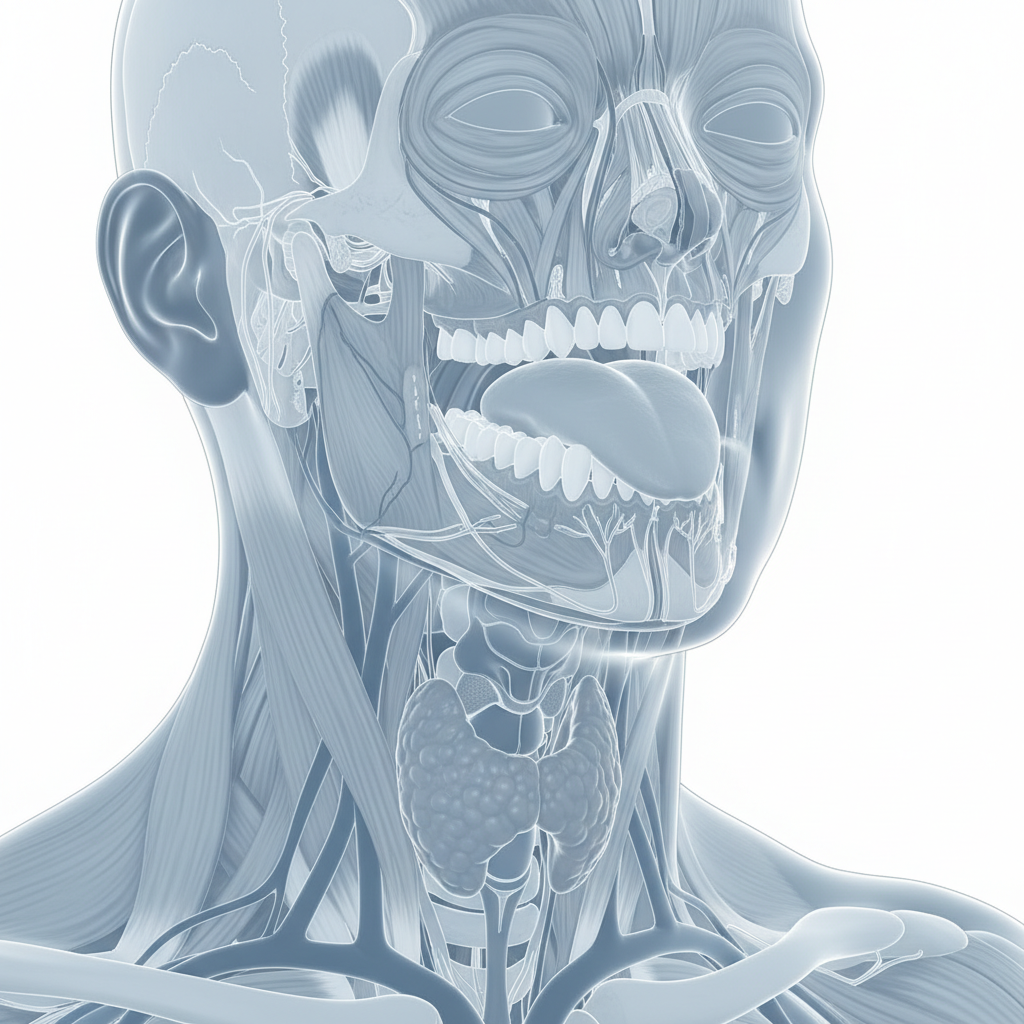
They begin in the moist linings of the mouth, nose and throat, or in the glands of the region — tongue, cheek, voice box, tonsil, thyroid, parotid and sinuses. In Gujarat most arise with tobacco, gutkha or areca nut use, or regular alcohol — though they also occur without any of these.
The useful truth: found early, many are cured with one well-planned operation, sometimes without radiation at all. Even advanced disease responds to combined treatment when staging is done properly first.
The neck lump rule. Any lump on the side of the neck lasting beyond three weeks deserves examination. It is often the first signal — and frequently the only one.
Signs that deserve a specialist’s eyes
Any of these persisting beyond three weeks — especially with a tobacco history — warrants examination. Most will prove innocent; the ones that are not are precisely why we check.
- ①A mouth ulcer that has not healed within three weeks, or bleeds when touched.
- ②A growing lump in the neck — painless lumps are ignored longest.
- ③Difficulty or pain swallowing, food seeming to catch on one side.
- ④Persistent hoarseness or voice change beyond three weeks.
- ⑤One-sided ear pain with a normal ear examination — a classic throat sign.
- ⑥Unexplained nosebleed or one blocked nostril that does not alternate.
- ⑦White or red patches inside the mouth that do not wipe away.
- ⑧Loose teeth or ill-fitting dentures without dental cause.
Cancers treated here
◆Mouth & Tongue
Oral cavity cancers — buccal mucosa, floor of mouth, alveolus, tongue — among the commonest in Gujarat.
◆Throat & Voice Box
Oropharynx, hypopharynx and larynx, with voice preservation prioritised wherever safely possible.
◆Thyroid
Papillary, follicular and medullary cancers, and complex goitres — the nerve to the voice box protected as standard.
◆Salivary Glands
Parotid and submandibular tumours managed with facial-nerve function as the first concern.
◆Nose, Sinuses & Facial Skin
Sinonasal tumours needing combined skull-base planning; skin cancers of the face.
◆Neck Nodes of Unknown Origin
A systematic search for the hidden primary — a discipline in itself.
Operations performed here
- ◆Composite resections for oral cancerPrecise margin control; rim, hemi or total glossectomy when required, with reconstruction planned from the outset.
- ◆Transoral laser surgeryNo external incision for selected throat cancers; faster return of speech and swallow.
- ◆Partial & total laryngectomyChosen only when voice-preserving options cannot safely cure — never by default.
- ◆ThyroidectomyBuilt on nerve-monitoring principles; the voice is measured before and after.
- ◆ParotidectomyFacial-nerve identification and preservation as standard practice.
- ◆Neck dissection & reconstructionRadical and modified radical clearance; local flaps and free-flap coordination for larger defects.
From first visit to full recovery
Examination & endoscopy
The tumour is seen directly; biopsies taken the right way, the first time.
Staging scans
MRI, CT and ultrasound map exactly what surgery must address.
Tumour board review
Radiation and medical oncology weigh in before decisions — not after.
Surgery
Curative resection with reconstruction, planned to the millimetre.
Rehabilitation
Speech and swallow therapy begins early — often within days.
Surveillance
Scheduled reviews catch anything new while it is still easy to treat.
Questions families ask first
In most cases, yes — voice preservation is the default consideration, not the exception. When total laryngectomy is genuinely necessary, modern voice restoration gives most patients strong, usable speech again. This is discussed before you consent, not after.
Laser procedures: a day or two. Major composite resections: typically seven to ten days including swallow training. You receive a written day-by-day expectation before consenting.
The common types carry excellent long-term cure rates — most patients live entirely normal lives on hormone tablets. The rarer types need more aggressive, individualised plans, discussed plainly.
It depends on final pathology — depth, margins, nodes. Early oral and thyroid cancers frequently avoid it altogether. The decision follows evidence, not habit.
Yes. A screening oral examination takes five minutes and can find precancerous change years before cancer. Help with quitting is part of the consultation — without judgment.