Curing the cancer while protecting the way you speak, swallow and smile.
Head and neck cancers sit where survival meets identity — they affect how we eat, talk, and are seen. Surgery here demands millimetre judgement: remove enough to cure, preserve everything that makes you you.
What are head & neck cancers?
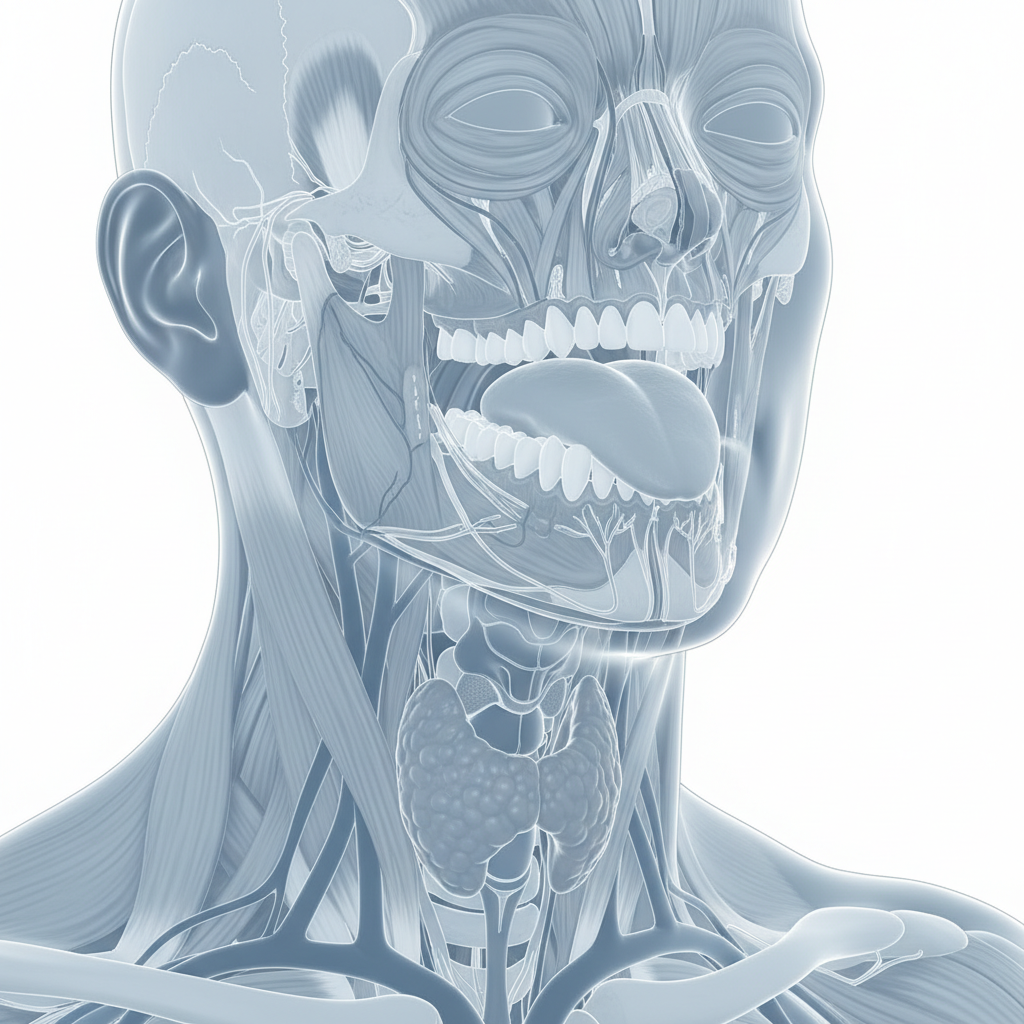
These cancers begin in the moist surfaces of the mouth, nose and throat, or in the glands of the region — tongue, cheek, voice box (larynx), tonsil, thyroid, parotid and sinuses. In Gujarat, most arise in people who chew tobacco, gutkha or areca nut, smoke, or drink alcohol regularly — but they also occur without any of these.
The encouraging truth: caught early, many are cured with a single well-planned surgery, sometimes without any radiation. Even advanced cancers respond remarkably to combined treatment when staging is done properly first.
The neck lump rule: any lump on the side of the neck lasting more than three weeks deserves examination — it is often the first signal, and it should never be ignored simply because it doesn’t hurt.
Eight signals that deserve a specialist’s eyes
Any of these lasting more than three weeks — especially with a tobacco history — warrants examination. Most will be innocent; the ones that aren’t are exactly why we check.
- ①A mouth ulcer that hasn’t healed within three weeks, or bleeds when touched.
- ②A growing lump in the neck — painless lumps are the ones people ignore longest.
- ③Difficulty or pain while swallowing, food “sticking” on one side.
- ④Persistent hoarseness or voice change beyond three weeks.
- ⑤One-sided ear pain with a normal-looking ear — a classic throat signal.
- ⑥An unexplained nose bleed, or one nostril staying blocked.
- ⑦White or red patches inside the mouth that don’t wipe away.
- ⑧Loose teeth or ill-fitting dentures without an obvious dental cause.
Cancers treated in this territory
◆Mouth & Tongue
Oral cavity cancers including buccal mucosa, floor of mouth and alveolus — among the commonest in Gujarat.
◆Throat & Voice Box
Oropharynx, hypopharynx and larynx — with voice preservation prioritised wherever safely possible.
◆Thyroid
Papillary, follicular and medullary cancers; recurrent laryngeal nerve preservation is non-negotiable.
◆Salivary Glands
Parotid and submandibular tumours with facial nerve function protected as standard practice.
◆Nose & Sinuses
Sinonasal malignancies requiring combined skull-base planning with allied specialists.
◆Facial Skin & Neck Nodes
Skin cancers of the face; neck node masses of unknown origin, worked up systematically to find the hidden primary.
Operations performed here
- ◈Composite resections for oral cancerTumour removal with precise margin control; rim, hemi or total glossectomy as needed, with reconstruction planned alongside.
- ◈Laryngectomy — partial & totalChosen only when voice-preserving options (laser, partial procedures) cannot safely cure.
- ◈Transoral laser surgeryNo external cut for selected throat cancers; faster recovery of speech and swallow.
- ◈Radical & modified radical neck dissectionClearing lymph nodes while protecting nerves and major vessels.
- ◈Thyroidectomy & parotidectomyNerve identification and monitoring principles followed as standard, not as exception.
- ◈Reconstruction planningLocal flaps and free-flap coordination with microvascular colleagues for larger defects.
From first visit to full recovery
Examination & endoscopy
The tumour is seen directly; biopsies are taken the right way, first time.
Staging scans
MRI, CT and ultrasound map exactly what surgery must address.
Tumour board plan
Radiation and medical oncology weigh in before decisions — not after.
Surgery
Curative resection with reconstruction, planned to the millimetre.
Rehabilitation
Speech and swallow therapy begins early — often within days of surgery.
Surveillance
Scheduled reviews catch anything early, while it is still easy to treat.
Families usually ask…
In the majority of cases, yes — voice-preservation techniques are the default consideration, not the exception. When total laryngectomy is truly necessary, modern voice restoration (tracheo-oesophageal puncture, electrolarynx) gives most patients strong, usable speech again.
Small laser procedures: 1–2 days. Major composite resections: typically 7–10 days including swallow training. You receive a written day-by-day expectation before consenting.
The common types (papillary and follicular) have excellent long-term cure rates — most patients live completely normal lives after surgery with hormone tablets. Medullary and rarer types need more aggressive, individualised plans, which we discuss honestly.
It depends entirely on final pathology — depth, margins, lymph nodes. Early oral and thyroid cancers frequently avoid it altogether. The decision follows evidence, not habit.
Yes — a screening oral examination takes five minutes and can catch precancerous changes years before cancer develops. Quitting support is part of the consultation too, without judgment.