Chapter 05 — The Craft
Speciality 05 · Thoracic OncologyCuring the cancer while protecting every remaining breath.
The chest holds the machinery of life itself. Thoracic surgery here follows a keyhole-first philosophy: VATS techniques that clear the disease through small cuts, preserve lung function wherever possible — and treat smokers and ex-smokers with support, never judgment.
Cancers of the chest
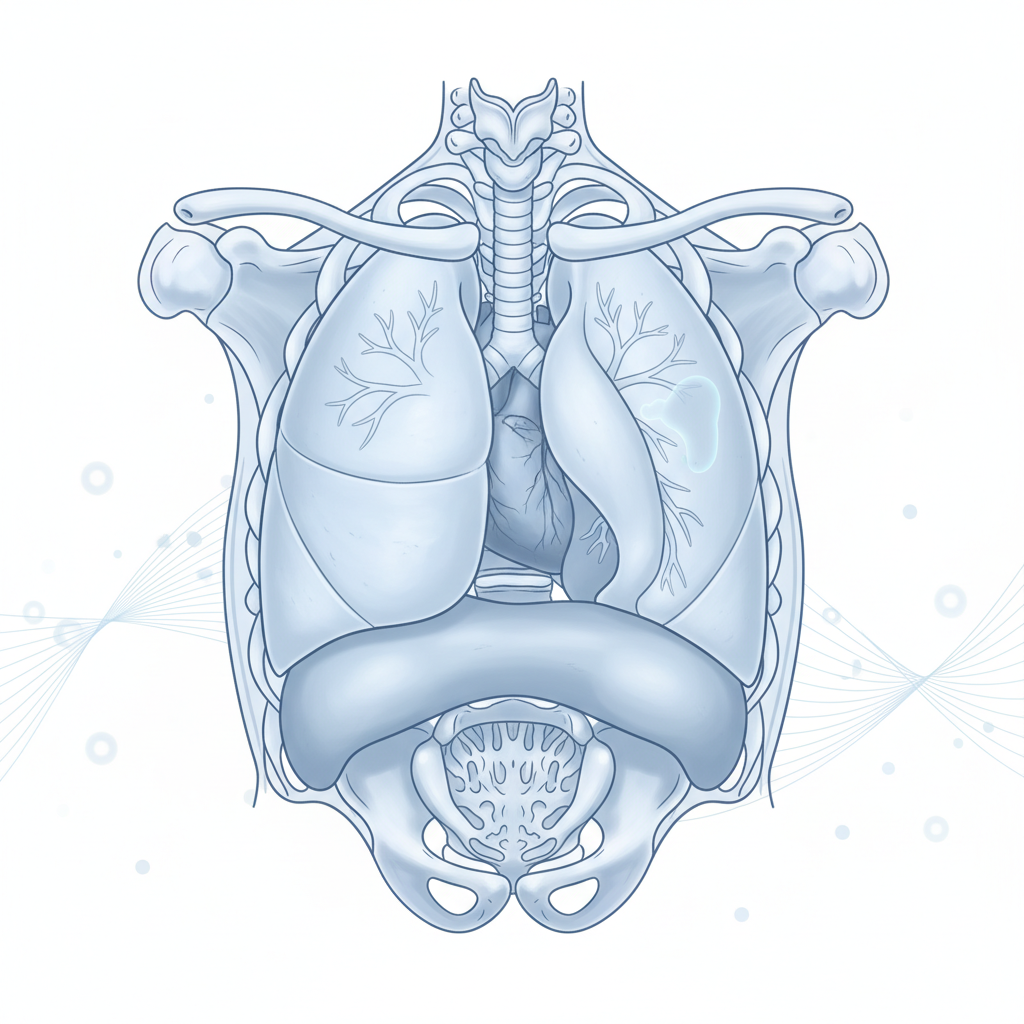
The chest contains more than lungs: the mediastinum between them (home to the thymus), the pleural lining around them, and the chest wall that shields everything. Tumours arise in all these places — lung cancer most commonly, but thymomas, mediastinal masses, mesothelioma and chest-wall tumours each demand their own craft.
The quiet revolution of this field is VATS — video-assisted thoracoscopic surgery. Through a few small cuts, a lobectomy can be done that once required a long incision spreading the ribs. Patients breathe easier sooner, hurt less, and start any needed chemotherapy on time.
Before any operation comes honest assessment: how much lung can this person spare? Pulmonary function testing answers it, and sometimes segmentectomy — removing just the involved segment — lets us keep even more.
And because many chest cancers trace back to tobacco, every consultation includes cessation support offered kindly. Blame is not medicine. Help is.
Signals that deserve imaging
A cough is usually just a cough. These patterns are different — and each is worth a proper examination and a scan.
- ①A cough persisting beyond three weeks, new or changed in character.
- ②Breathlessness that has changed — stairs you used to manage now manage you.
- ③Blood-streaked sputum, even a single fleck, even once.
- ④Chest pain on one side, persistent or worse with deep breaths.
- ⑤Hoarseness of voice without cold or strain to explain it.
- ⑥Pneumonia recurring in the same spot — infection returning where a tumour may block an airway.
- ⑦Finger clubbing — nails curving over enlarged fingertips, a subtle classic sign.
- ⑧An abnormal shadow on a routine chest X-ray, even without symptoms — always worth expert review.
Conditions we operate on
✳Early Lung Cancer
Nodules and stage I–II disease ideal for VATS lobectomy or segmentectomy.
✳Locally Advanced Lung Cancer
Open approaches, sleeve resections and combined plans when the tumour demands more.
✳Thymoma & Thymus Disease
Thymectomy for thymomas — often linked with myasthenia, treated as one picture.
✳Mediastinal Masses
Growth between the lungs worked up carefully before removal.
✳Pleural Disease & Mesothelioma
Recurrent effusions managed with pleurodesis; mesothelioma assessed honestly for what surgery can add.
✳Chest Wall Tumours
Resection with reconstruction that keeps the bellows strong and the frame intact.
Every breath kept is worth as much as every cell removed.
Operations performed here
- ✳VATS lobectomy & segmentectomyKeyhole removal of lobe or segment — less pain, quicker recovery, same oncological goal.
- ✳Open lobectomy & pneumonectomyChosen when the anatomy or extent truly requires it — skill, not habit, decides.
- ✳Sleeve resectionsAirway rebuilt so a whole lung needn’t be sacrificed.
- ✳Thymectomy & mediastinal excisionMasses between the lungs removed via approach best suited to their position.
- ✳PleurodesisStopping recurring fluid so breathing stays comfortable through treatment.
- ✳Chest wall resection + reconstructionTumours of the frame removed and rebuilt to protect both structure and breath.
From first visit to full recovery
History & CT review
Your story first, then the scan read personally, slice by slice.
Biopsy & PET staging
Tissue proof and whole-body staging before commitments are made.
Lung function testing
How much lung can safely go? Measured, not guessed.
Surgery — keyhole where possible
VATS-first, open when wiser, sleeve when it saves lung.
Chest physio & early walking
Recovery starts hours after theatre, with your lungs as the project.
Surveillance & quitting support
Scans on schedule; smoking-cessation help offered at every visit, gently.
Families usually ask…
For suitable tumours, VATS gives equal cancer outcomes with less pain and faster recovery — which is why it’s our default consideration. Open surgery remains the right choice when anatomy or extent demands it. The recommendation will be specific to your case.
Most patients return to their previous daily activities after losing one lobe — the remaining lung expands and adapts. Pre-operative lung-function testing exists precisely to predict this, and segmentectomy preserves even more when possible.
Usually yes, though not universally — small strongly-suspicious nodules in the right patient sometimes justify proceeding directly, discussed case by case. Proof matters; so does pragmatism.
Nodal spread changes the sequence rather than ending hope: often chemotherapy or immunotherapy comes first, then reassessment and surgery where disease responds. Plans are made in tumour boards, not in single opinions.
No. You’ll be treated with full commitment and supported toward quitting — because stopping helps wounds heal and lowers complications. Judgment helps no one breathe; we know that.