Clearing the cancer completely — and honouring how you feel about your body afterwards.
Oncoplastic surgery means both goals count as success here: cancer-free margins and a natural appearance. Neither is negotiable; neither is an afterthought.
What does breast cancer care look like here?
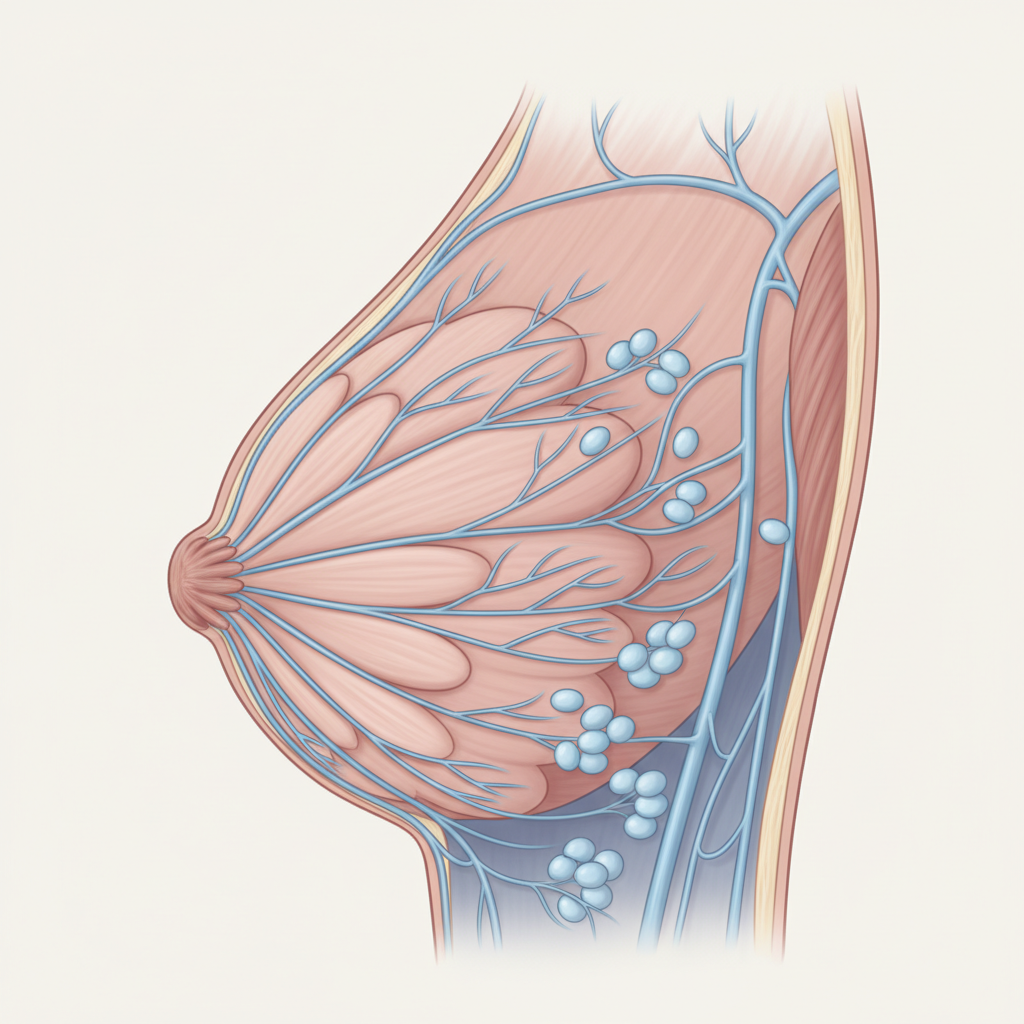
The centrepiece is the oncoplastic technique — cancer clearance and natural appearance planned in the same operation. Lumpectomy with reshaping wherever the tumour allows it; mastectomy options, including skin-sparing and nipple-sparing approaches, when it doesn't.
Around that sit the quieter decisions that matter just as much: sentinel lymph node biopsy to avoid unnecessary armpit surgery, rapid pathology reports so you're not left waiting, and honest answers about whether chemotherapy belongs in your plan at all.
For young women, fertility and family-planning counselling happens before treatment starts — not after. And benign lumps are treated with the same seriousness: quick answers, no lingering anxiety.
Eight signals worth a check-up
Most turn out to be benign — but every one of them deserves imaging and a clear answer rather than watchful worry.
- ①A painless lump in the breast — the commonest sign, and the most ignored.
- ②Skin dimpling — the "orange peel" texture on the surface.
- ③Nipple retraction — a nipple turning inward.
- ④Blood-stained discharge from the nipple.
- ⑤A change in the size of one breast.
- ⑥A change in shape or contour that is new to you.
- ⑦New asymmetry between the breasts.
- ⑧An axillary lump — under the arm, even when the breast feels normal.
What this region covers
◆Breast Conservation
Lumpectomy combined with oncoplastic reshaping — cancer clearance and appearance together.
◆Mastectomy Options
Simple, skin-sparing and nipple-sparing approaches, matched to the tumour and to you.
◆Sentinel Node Biopsy
Accurate staging of the armpit while avoiding unnecessary axillary surgery.
◆Axillary Dissection
Performed precisely, only when nodes are genuinely involved.
◆Benign Lumps
Rapid assessment and reassurance — most lumps are not cancer, and proving it quickly matters.
◆Reconstruction Coordination
Planned alongside reconstructive colleagues so the whole journey is mapped before the first cut.
Operations performed here
- P·01Breast conservation surgeryLumpectomy plus oncoplastic technique — wide clearance with natural contours preserved.
- P·02Mastectomy — simple / skin-sparing / nipple-sparingChosen by tumour behaviour and your preference, discussed without pressure either way.
- P·03Sentinel lymph node biopsyThe modern standard — find the first draining node, spare the rest when it's clear.
- P·04Axillary dissectionComplete nodal clearance when genuinely indicated.
- P·05Benign lump excisionMinimal, precise, scar-aware.
- P·06Reconstruction coordinationTimed with reconstructive colleagues — immediate or delayed, mapped in advance.
From suspicion to surveillance
Listen first
Your history and worries heard unhurried — including fertility plans if they matter to you.
Imaging & biopsy
Mammogram, ultrasound, core biopsy coordinated; rapid pathology reports.
Honest plan
Conservation vs mastectomy laid out plainly, with chemotherapy's role stated early if relevant.
Surgery
Oncoplastic technique chosen for this body, this tumour.
Recovery together
Daily rounds, physio, drain care taught, family updated.
Life after
Surveillance schedule and follow-up treatment sequenced — back to your life.
Families usually ask…
For appropriately selected tumours, survival outcomes are equivalent in properly done conservation plus radiation. The decision depends on tumour size relative to the breast, its biology, and your preference — all weighed openly with you.
Not always — it depends on stage, grade and receptor status, decided with medical oncology after surgery gives complete information. Where chemo-first shrinkage would enable better surgery, we say that upfront.
Oncoplastic technique exists precisely for this: reshaping at the time of lumpectomy so the treated breast keeps a natural form. Many patients tell us they cannot point to where the surgery was.
Most women resume desk work within two to three weeks after conservation surgery; mastectomy recovery takes somewhat longer. You get a realistic timeline written down before admission.
Always — fertility and family-planning counselling is part of the plan for every young woman here, arranged before treatment begins so options stay open.