Curing the cancer while protecting how you speak, swallow and are seen.
Head and neck cancers sit where survival meets identity — they touch eating, speech and appearance. Surgery here demands millimetre judgement: remove enough to cure, preserve everything that makes you, you.
What are head & neck cancers?
They begin in the moist linings of the mouth, nose and throat, or in the glands of the region — tongue, cheek, voice box (larynx), tonsil, thyroid, parotid and sinuses. Some appear first as a swelling in the neck that seems connected to nothing at all.
The encouraging truth: caught early, many are cured with a single well-planned operation, sometimes without radiation at all. Even advanced ones respond remarkably when staging is completed before decisions — not after.
The neck-lump rule is simple: any lump on the side of the neck lasting more than three weeks deserves examination. Most turn out innocent; the ones that aren't are exactly why we check.
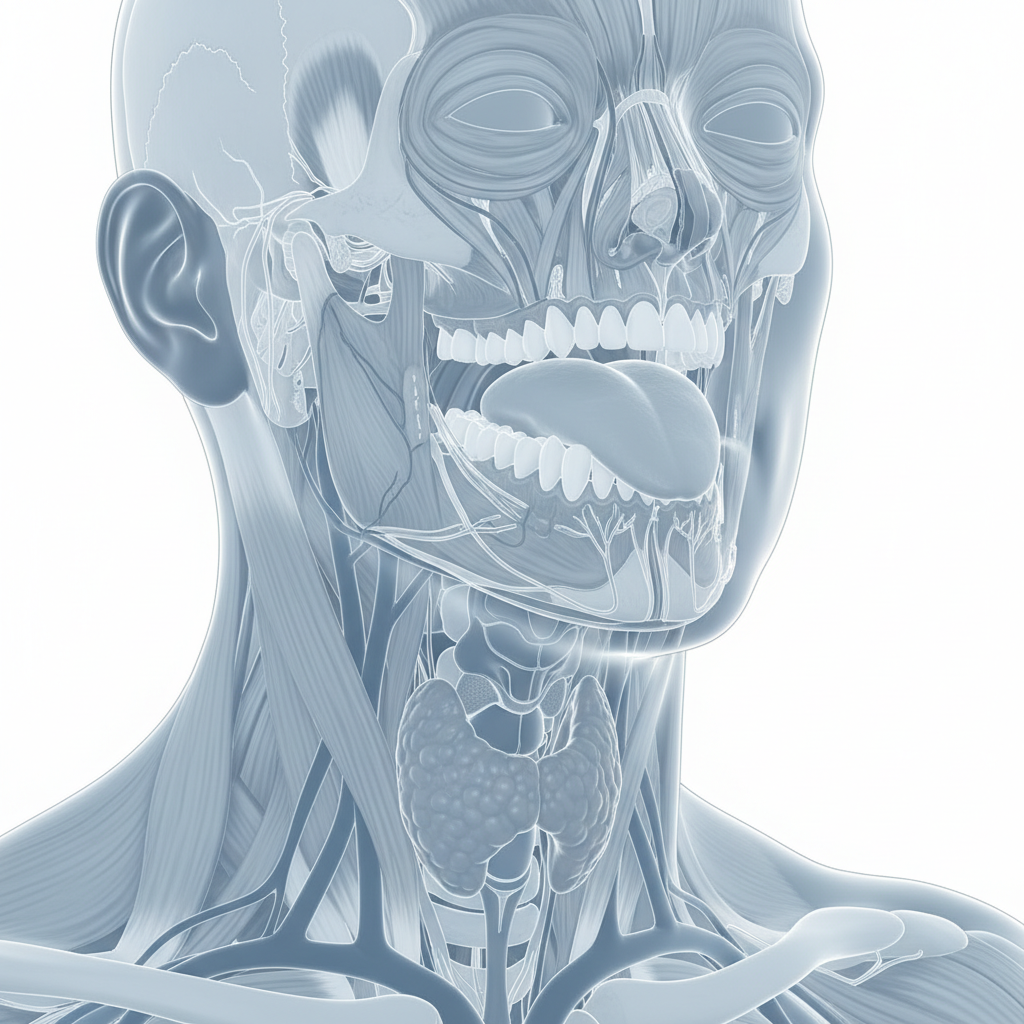
Eight signs that deserve a specialist's eyes
Any of these lasting beyond three weeks warrants examination. Most will be innocent; the ones that aren't are exactly why we look.
- ①A mouth ulcer that hasn't healed in three weeks, or bleeds easily when touched.
- ②A lump in the neck that is growing — painless lumps are ignored longest.
- ③Difficulty or pain swallowing, food seeming to stick on one side.
- ④Persistent hoarseness or voice change going past three weeks.
- ⑤One-sided ear pain with a normal-looking ear — a classic throat signal.
- ⑥An unexplained nose bleed or one persistently blocked nostril.
- ⑦White or red patches inside the mouth that don't wipe away.
- ⑧Loose teeth or dentures that no longer fit, without dental cause.
Cancers treated in this region
◆Mouth & Tongue
Oral cavity and tongue cancers — including lesions of the cheek, floor of mouth and gums.
◆Throat
Oropharynx and hypopharynx tumours, planned around function wherever safely possible.
◆Voice Box (Larynx)
Laryngeal cancers with voice preservation prioritised whenever oncology allows it.
◆Thyroid
Thyroid malignancies operated with recurrent-laryngeal nerve protection as standard.
◆Salivary Glands
Parotid and submandibular tumours, with facial movement guarded throughout.
◆Nose, Sinus, Skin & Neck Nodes
Sinonasal tumours, facial skin cancers, and neck node masses worked up to their source.
Operations performed here
- ◆Composite resections for oral cancersHemi or total glossectomy included when required, planned to the millimetre.
- ◆Transoral laser surgeryNo external cut for selected throat cancers — faster recovery of speech and swallow.
- ◆Laryngectomy — partial & totalChosen only when voice-preserving options cannot safely cure.
- ◆ThyroidectomyPerformed with nerve-monitoring principles to protect the voice.
- ◆ParotidectomyFacial-nerve identification and preservation as standard practice.
- ◆Radical & modified radical neck dissectionNodes cleared while protecting nerves and vessels, with reconstruction planning coordinated.
From first visit to full recovery
Examination & endoscopy
The area is seen directly; biopsy taken the right way, first time.
Staging scans
MRI/CT and ultrasound map exactly what surgery must address.
Tumour board plan
Radiation and medical oncology weigh in before — not after — decisions.
Surgery
Curative resection with reconstruction, planned millimetre by millimetre.
Rehabilitation
Speech and swallow therapy begins early — often within days.
Surveillance
Scheduled reviews catch anything early, while it is still easy.
Families usually ask…
In most cases, yes — voice-preserving techniques are the default consideration here, not the exception. When a total laryngectomy truly is necessary, we discuss it openly beforehand and plan rehabilitation so that strong, usable communication returns.
It depends on the operation — small laser procedures need far less time than major composite resections. You receive a written day-by-day expectation before consenting, so nothing about recovery is a surprise.
The common types generally carry excellent long-term outcomes with surgery and hormone tablets. Less common types need individualised plans — which we explain honestly rather than rushing you to theatre.
Depends entirely on final pathology — depth, margins, nodes. Early cancers frequently avoid it altogether. The decision is made on evidence from your own reports, not habit.
Please do — bring whatever reports exist. Sometimes the advice is "your current plan is right", and we will say exactly that. An honest plan sometimes includes no operation at all.