Keyhole-first chest surgery that protects every remaining breath.
In lung surgery the question is never only removing the cancer — it is how much breathing you keep afterwards. VATS keyhole technique, careful lung-function planning and honest staging decide that balance in your favour.
What is thoracic oncology?
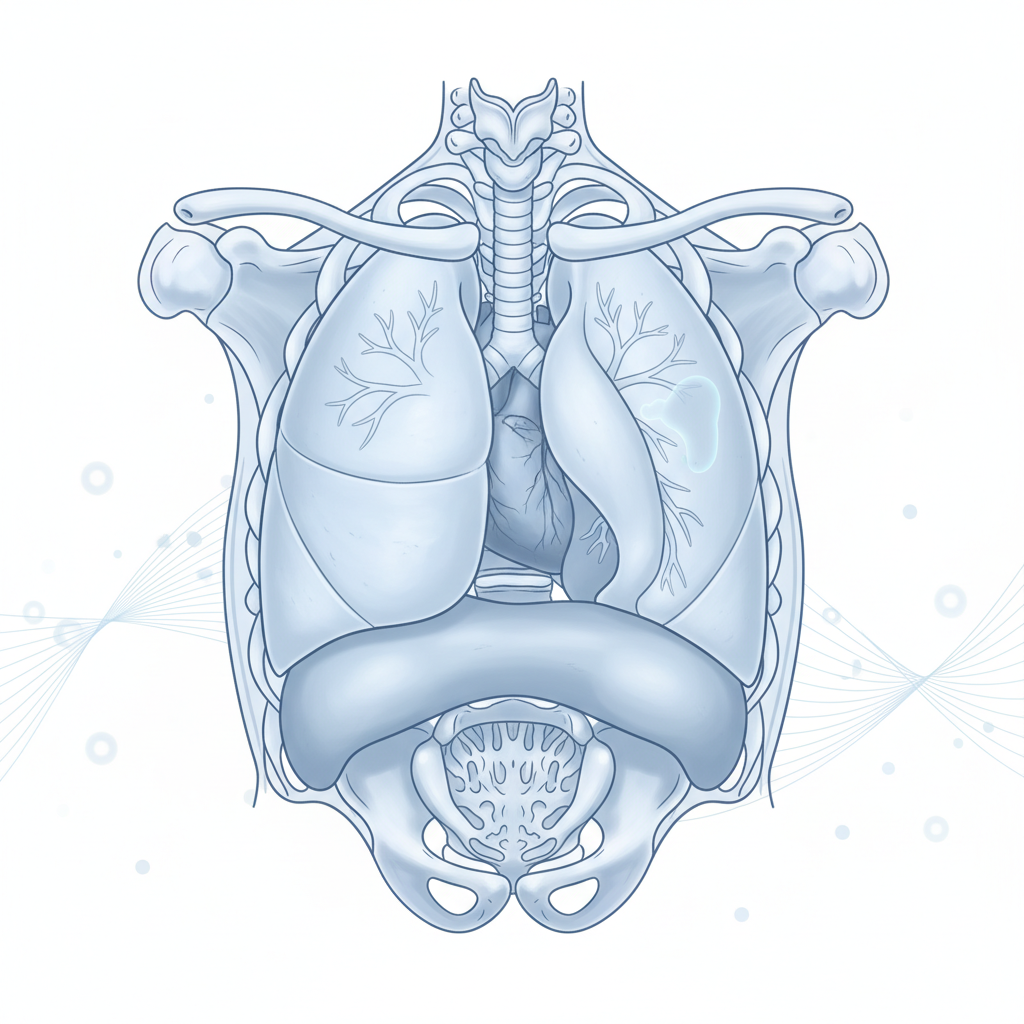
This field covers cancers of the lung, masses of the mediastinum (the space between the lungs, including thymoma), diseases of the pleura (the lining around the lung, including mesothelioma), and chest wall tumours.
The encouraging truth: for early lung cancer, VATS keyhole lobectomy or segmentectomy removes the cancer through a few small cuts instead of opening the chest — less pain, fewer complications, and better preserved breathing afterward.
A note without judgment: whether you smoked or never did, your treatment here is identical in urgency, respect and effort. Quitting support is offered alongside, never as a condition of care.
Warning signs that deserve a scan
Smoker or not — a symptom below that outlives three weeks earns proper investigation, not a guess.
- ①Cough lasting beyond three weeks — new or changed from your usual.
- ②Breathlessness that has changed — stairs suddenly harder than last year.
- ③Blood-streaked sputum, even once, even a single streak.
- ④Chest pain on one side, persistent and not muscular in pattern.
- ⑤Hoarseness beyond three weeks — the nerve to the voice box runs through the chest.
- ⑥Recurrent pneumonia on the same side — an infection that keeps returning to one spot needs looking behind.
- ⑦Finger clubbing — fingertips widening and nails curving; worth showing a doctor.
- ⑧An incidental lung nodule on any X-ray or scan — small findings deserve specialist review, not automatic panic.
Conditions we treat in this region
◆Early Lung Cancer
Stage I–II disease — the best candidates for VATS keyhole resection with excellent outcomes.
◆Locally Advanced Lung Cancer
Larger or central tumours needing open lobectomy, pneumonectomy or sleeve resections after honest board review.
◆Mediastinal Masses
Tumours between the lungs approached through routes chosen for safety first.
◆Thymoma
Thymus tumours — sometimes linked with myasthenia gravis, planned together with neurology when so.
◆Pleural Disease & Mesothelioma
Fluid control with pleurodesis and tissue diagnosis for lining-of-lung cancers.
◆Chest Wall Tumours
Resection with reconstruction restoring both protection and appearance.
Operations performed here
- ◆VATS lobectomy / segmentectomyKeyhole removal of lobe or segment — the default approach wherever oncologically sound.
- ◆Open lobectomy / pneumonectomyChosen when anatomy or extent genuinely demands it — competence in both, bias toward neither.
- ◆Sleeve resectionsRemoving part of an airway and rebuilding it, saving whole-lung removal where possible.
- ◆Thymectomy & mediastinal mass excisionRoutine and complex cases with airway and vessel protection prioritised.
- ◆PleurodesisLasting relief for recurring fluid around the lung.
- ◆Chest wall resection & reconstructionProsthetic or flap reconstruction so structure and appearance both return.
From first visit to full recovery
Imaging review
Your CT/PET read personally; nodules measured against strict criteria.
Tissue diagnosis
Biopsy obtained the safest way — often via bronchoscopy or needle.
Fitness testing
Lung function tests quantify exactly what surgery must protect.
Tumour board plan
Surgery, radiation or drug therapy sequenced for maximum benefit.
Surgery
VATS-first resection with systematic nodal sampling.
Recovery & surveillance
Chest physiotherapy from day one; scheduled scans thereafter.
Families usually ask…
For suitable early cancers, keyhole VATS offers the same cancer control with less pain and faster recovery — it is our default. Open surgery is not outdated though: some central or large tumours are simply safer through it. The plan follows your anatomy, not a preference.
This is what pre-operative testing answers precisely. We remove only what lung-function numbers allow. Most patients walk comfortably, climb stairs and return to daily activity — segmentectomy exists specifically to preserve more breathing capacity.
Almost always — treating the wrong disease helps no one. Rarely, highly characteristic scans in fit patients justify proceeding directly; if yours is such a case, we will say so and explain why.
Nodal spread changes the sequence rather than ending hope — often chemotherapy or immunotherapy comes first, then reassessment, then surgery in selected patients. Every step is decided at the board, with evidence.
No. Smoking history affects anaesthetic preparation and wound care, so we support quitting — but refusal is not our practice. You will be treated now and helped to quit alongside, without judgment.